Toronto
Station ElevenToronto is where a theatrical death, a personal revelation, and the first visible warnings of the Georgia Flu converge. The city is more than the setting for Arthur Leander’s collapse at the Elgin Theatre: its snowbound streets carry Jeevan Chaudhary away from the performance and toward a new understanding of his life, while the city’s hospitals and shops register the approaching emergency in public and practical terms. Later, remembered Toronto becomes a measure of what has vanished and what persists.
The Theatre and the City
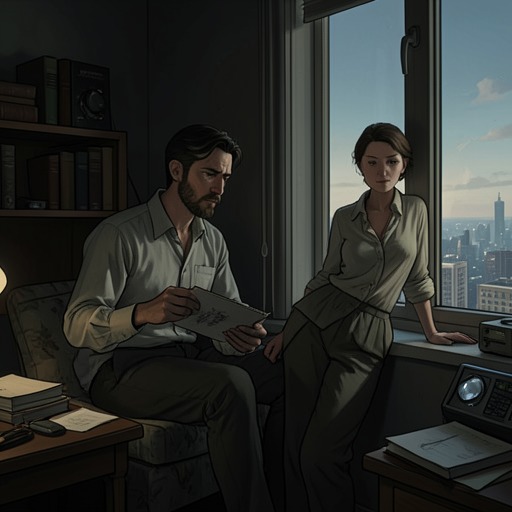
On a winter night, Arthur Leander plays King Lear at the Elgin Theatre in Toronto. In Act Four, the performance moves between the theatrical world of the mad king and the immediate reality of Arthur’s failing condition. Earlier in the evening, three girls had played a clapping game onstage; now they return in his hallucinations as the children who played Lear’s daughters. Arthur, fifty-one, reaches toward them beneath the stage lights. His changed expression, unsteady movement, and difficulty speaking first leave room for the possibility that he is acting, but the scene soon draws an audience member from his seat: Jeevan, who has been training to become a paramedic. The theatre is thus both a working stage and the site of an emergency in which performance can no longer be confidently separated from life.
The city’s snow becomes part of the connection between the theatre and the streets outside. After the incident, Jeevan walks through Toronto rather than taking a cab. His route carries him north on Yonge Street, with red streetcars passing, and onto Carlton Street. At Allan Gardens, roughly halfway to his home in Cabbagetown, he recognizes with sudden certainty that he wants to be a paramedic. Arthur could not be saved, but Jeevan’s response to the event changes his sense of what he should do: when others can only watch, he wants to step forward. The walk turns a public tragedy into a decision about his own future.
Routes, Landmarks, and Warning Signs
Toronto’s geography organizes Jeevan’s movement through the night. On a later passage south along Yonge Street, he heads toward the lake and the tower where his brother Frank lives. The Elgin Theatre is dark; its posters still show Arthur beneath blue light, holding Cordelia. Jeevan pauses to look at them, then continues through the nearly deserted street and the orange-lit shadows beneath the Gardiner Expressway. When he reaches Queens Quay, the weather is wilder by the lake, and he has finally arrived at Frank’s building. These named routes and structures place the crisis within a recognizable city crossed on foot, not in an abstract disaster landscape.
A call from Hua changes what Jeevan understands about the night. Hua has been working with patients and warns him to leave if possible, or otherwise to obtain food and remain in his apartment. Because Jeevan trusts Hua’s judgment, the warning makes the possibility of an epidemic feel immediate. He turns away from Frank’s building and enters a grocery store near the harbour. A television above the film-development counter reports that Toronto General Hospital and two other local hospitals have been placed under isolation, and that Health Canada has confirmed an outbreak of the Georgia Flu. Officials give no numbers, while the broadcast reports fatalities and questions whether Georgian and Russian officials have been candid about the crisis. The message to stay calm sits beside details that make calm difficult to sustain.
Jeevan responds by filling an oversized shopping cart with water. The load is so heavy that it becomes difficult to manage in the snow; on the ramp outside, the cart slides sideways into a planter. The incident is small beside the hospital warning, but it shows how public information is translated into immediate action, uncertainty, and practical difficulty. Toronto’s ordinary commercial spaces have become places where residents try to decide what a newly announced emergency requires.
A City Revisited Through Memory
The city also holds the older lives of people whose present is unsettled. On a day when Arthur leaves the theatre after a long argument over notes, exhausted and unable to settle, he takes a cab to Queen West and Spadina. He is looking for a diner he used to visit with Clark Thompson when they were seventeen. The neighborhood has changed: shops and cafés he knew have disappeared. The diner, however, seems eerily unchanged, with its red upholstered booths, counter stools, and old clock. Arthur’s recollection of the waitress proves unreliable, but the place draws him back to nights when he and Clark took acting classes, Arthur worked as a waiter, and Clark spent a small inheritance. The return makes the city legible as layers of time: a familiar street can be altered, while one interior seems to preserve an earlier life.
Toronto’s importance is not confined to the hours before the outbreak becomes public. Much later, while living at McKinley, Jeevan sits beside a river after helping a wounded woman. The sight of the needle he has cleaned and the water he has set to boil leads his thoughts back to his brother, the tower beside the lake, and Toronto as a ghost city crumbling in memory. That recollection leads in turn to the Elgin Theatre and the night Arthur died, which Jeevan understands as the beginning and the end of everything. The remembered city is therefore both a specific place—its theatre, streets, and lakeside tower—and a compressed point of origin for a life transformed by loss and survival.
Narrative Significance
Toronto brings separate kinds of change into close proximity. Arthur’s collapse interrupts a performance; Jeevan’s walk converts helplessness into a vocational decision; Hua’s warning and the broadcast from Toronto General Hospital turn an uncertain threat into a reason to prepare. The city’s routes bind these developments together, from the theatre and Allan Gardens to Cabbagetown, the harbour, and the apartment tower. Its public landmarks also acquire private meanings: the poster outside the darkened theatre returns Jeevan to Arthur, while the old diner returns Arthur to his early friendship with Clark Thompson.
The later recollection at McKinley gives Toronto a further function. It is no longer simply the city where events occurred but the place through which Jeevan measures the distance between the world before the outbreak and the life that followed. The book preserves this transition in concrete urban details—streetcars, snow, a grocery cart, a theatre poster, and a diner—without treating the city as untouched or timeless. Some of its familiar places have changed, others remain recognizable, and all are carried forward as fragments of a life that can no longer be resumed in the same form.